

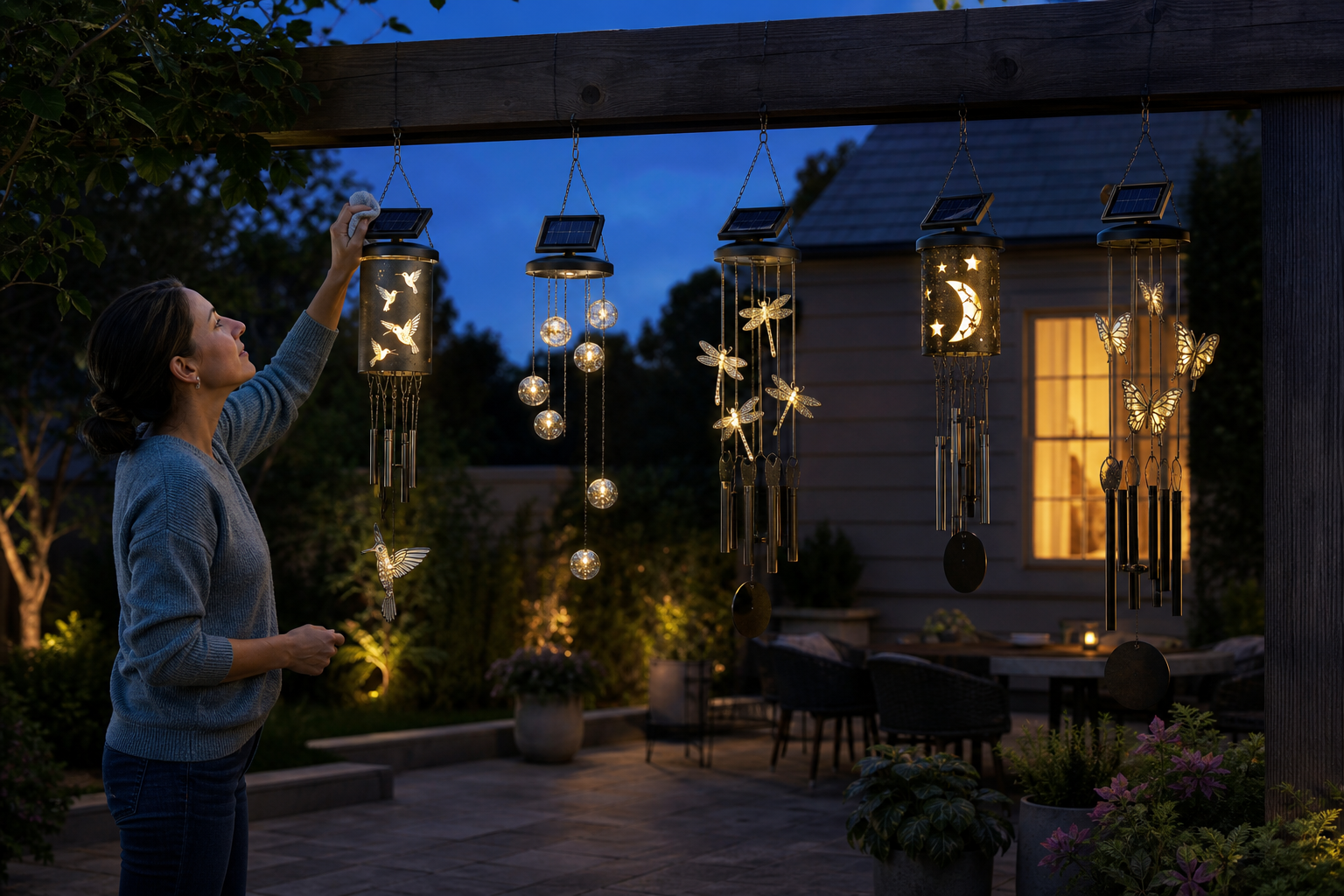
The short answer: hang a solar LED wind chime from a sound, weather-appropriate support where its solar collector can receive the sunlight specified by the current listing, its moving parts have clear space, and its light and sound will not spill unnecessarily into a neighbour’s home. Clean gently, inspect the suspension hardware often, and bring the decoration in when conditions exceed its stated limits.
Runtime, charging speed and brightness vary with panel size, battery condition, season, shade, temperature and recent weather. A title using “weatherproof,” “colour changing” or “outdoor” is not a lifetime or performance guarantee. Read the selected variant’s live specifications and instructions before installation.
Match the design to the location
| Design | Visual feature | Placement question |
|---|---|---|
| Hummingbird | Multiple hanging bird elements | Is there clear swing space around every figure? |
| Solar ball | Round illuminated drops | Can balls move without striking a wall or each other? |
| Dragonfly | Wide wing shapes | Are delicate edges protected from branches and traffic? |
| Moon and star | Distinct night motif | Will the display face your own seating area rather than a window? |
| Butterfly | Several lightweight figures | Is the hanging point sheltered enough for the stated wind limits? |
Start with the five current listings
Compare the current dimensions, materials, controls and included hardware for the LED Hummingbird Solar Wind Chime, Solar Ball Wind Chimes, Dragonfly Wind Chime, Moon Star Solar Chime and Butterfly Solar Wind Chimes.
Product titles mention features such as colour changing or weather resistance, but verify what the detailed specification actually says for the chosen variant. Look for an ingress or outdoor-use rating, battery information, switch position, first-charge instructions and any temperature, wind or storage limits. If a specification is absent, do not invent one.
Choose a secure hanging point
- Measure the full hanging length, including hook, solar top, strands and lowest sail.
- Add clearance for side-to-side movement; never place it where it can hit glass, siding, a fan, power line or another decoration.
- Use a structural hook and support rated for the complete item and local conditions.
- Keep it above normal head height but accessible from the ground for switching and inspection.
- Do not improvise installation from a chair. Use an appropriate ladder with a helper when height work is necessary.
A tree branch changes diameter and moves in wind, while a pergola or eave may require owner-approved hardware. Renters should obtain permission before drilling. Keep cords and small pieces away from children and pets.
Give the solar collector useful daylight
Solar cells generate electricity from light, but shade and surface dirt reduce what reaches them. Face the collector toward open sky as directed, away from dense leaves, roof shadows and other structures. Observe the location at several times of day because a sunny morning position may be shaded later.
Turn the unit on if its instructions require the switch to be on while charging. Follow the stated initial-charge procedure. Do not promise a certain number of nighttime hours: a cloudy winter day and a clear summer day are different inputs, and rechargeable batteries lose capacity with age.
Test before permanent placement
Charge and test the chime at ground level first. Cover the panel briefly only if the instructions use darkness to activate the light. Confirm that the switch, sensor and hanging parts work, then uncover it. A daylight test prevents unnecessary ladder trips.
Listen as well as look. Wind chimes create sound that carries differently at night. Try a temporary location for several evenings and move it if the tone enters bedrooms, echoes between walls or becomes intrusive during ordinary breezes.
Keep the display neighbour-friendly
DarkSky International recommends outdoor lighting that is useful, targeted, low-level, controlled and warm-coloured where possible. A decorative chime cannot always be aimed like a fixed fixture, so choose distance and orientation carefully. Keep light within your property, away from windows, wildlife habitat and the open sky.
If the unit has a switch, turn it off when no one is enjoying it or during local quiet hours. Solar charging does not create an obligation to illuminate all night. Follow bylaws, building rules and neighbour requests. One modest focal point is often more considerate than clustering many moving lights together.
Seasonal cleaning routine
- Switch the unit off and bring it to a stable work surface.
- Remove loose dust with a soft dry cloth.
- Wipe the solar panel gently with the method allowed by the instructions; avoid abrasives.
- Untangle strands without pulling on electrical leads.
- Inspect hooks, rings, knots, wires, housings and decorative pieces for cracks, corrosion or looseness.
- Let every component dry completely before switching on or rehanging.
A gentle spring check removes winter residue; midsummer checks catch pollen and leaf shade; autumn care clears debris; and a pre-winter decision determines whether the model should be stored. Cleaning frequency depends on local dust, trees, salt air and weather.
Bad weather and winter storage
Take the chime down before severe wind, hail, ice accumulation or other conditions beyond its instructions. “Weatherproof” does not mean storm-proof. Freezing temperatures can affect some rechargeable batteries, plastics and finishes. Use the manufacturer’s temperature and storage directions rather than a general promise.
Clean and dry the item before storage. Coil or separate strands so they do not knot, protect delicate figures with soft material, and store in a dry place away from extreme heat and children. Do not discard a rechargeable battery in household trash; follow its label and local battery-recycling rules.
Troubleshooting without guessing
If the light does not activate, verify the switch, remove protective film if documented, give the stated charge, clean the panel and test away from bright porch lights that may influence a darkness sensor. If only part of the decoration lights, inspect visible connections without opening a sealed housing.
Stop using a unit with heat, swelling, leaking battery material, burnt odour, cracked wiring or water inside a housing not designed to open. Contact the seller for model-specific help. Do not mix battery types or install a replacement with different specifications.
Frequently asked questions
How long should a solar chime glow?
There is no universal runtime. Use the listing as an estimate only and expect sunlight, season and battery condition to affect results.
Will it change colour exactly as pictured?
Verify the selected variant and current description. Screens and photography can also change how colours appear.
Can it stay outside all winter?
Only within the product’s documented temperature and weather limits. Store it when those limits are unknown or likely to be exceeded.
Where is the best charging spot?
A secure location with useful daylight on the collector and clear movement space, without creating light or sound nuisance.
Is outdoor wording a durability guarantee?
No. Outdoor suitability has limits, and materials, finish, battery and hardware still require inspection and care.
Bottom line
Secure the support, give the panel useful daylight, leave movement clearance, test light and sound from a neighbour’s perspective, and inspect seasonally. Let the selected listing—not its title alone—set expectations for colour, weather exposure and runtime.