
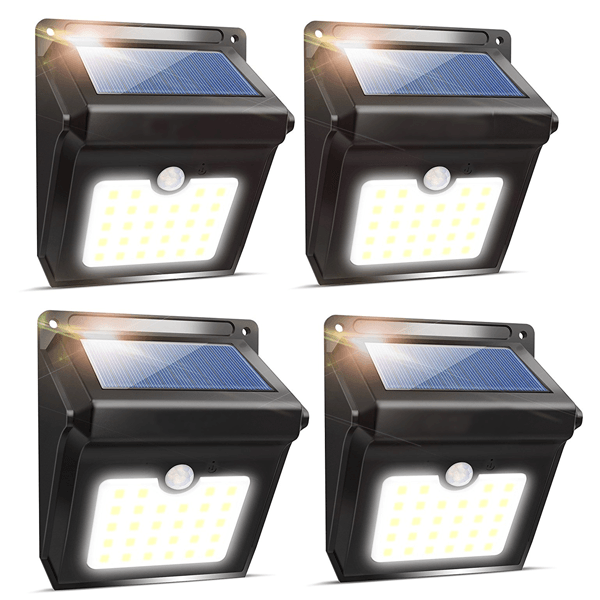
Quick answer: Match the light to the job. The $9.99 wall puck (16 LEDs, motion detection listed at ~10 feet) covers a doorway, shed, or flight of steps. The 3-head garage and courtyard light (210 LEDs, rated 2,500 lumens, detection listed to ~26 feet, remote with three modes) covers driveways and wide walls. Both are solar and screw-mounted — no wiring.
Motion sensor lights are the most functional thing we sell: no decoration, just fewer dark corners. We carry two very different takes, and customers buy both in volume — 75 wall pucks and 54 of the 3-head units since mid-January 2026. This guide covers what each does, where it belongs, and the two placement rules that make or break any solar motion light.
Two designs, two philosophies
The Outdoor Motion Sensor Light is a compact puck you scatter around the property: one over the side door, one on the shed, one by the bin store. At $9.99 each, coverage comes by quantity. The Solar Motion Sensor Light for Garage & Courtyard is the opposite: one serious fixture with three adjustable heads aimed at a whole zone — a driveway, a courtyard, a garage face. Same principle, different scale.
The wall puck: small, cheap, everywhere
The puck packs 16 LEDs into a heatproof ABS housing with an IP65 rating and a built-in rechargeable lithium battery. Its sensor is listed at about 10 feet across a 120-degree angle, running two behaviors: a dim standby glow at night, switching to bright on movement, then back down once clear. It turns on at night, off at sunrise. Mounting is two included screws into a wall or fence — minutes, start to finish. What it won't do is cover distance: 10 feet is a doorstep, not a driveway.
The 3-head: coverage and control
The garage and courtyard unit spreads 210 LEDs across three adjustable heads, for a listed 270 degrees of coverage and a rated 2,500 lumens at 6,500K — crisp, white, security-style light. Motion detection is listed at up to 26 feet, and a 2,000mAh battery stores the day's charge. The remote is the surprise here: instead of a ladder, switch between three modes from the ground. Each unit ships with remote, screws, and a manual. Pricing: $29.99 for one, $34.99 for two, $54.99 for three, $69.99 for four.
Head to head
| Wall puck | 3-head unit | |
|---|---|---|
| LEDs | 16 | 210 |
| Brightness | Not rated on listing | Rated 2,500 lumens, 6500K |
| Detection (listed) | ~10 ft, 120° | ~26 ft |
| Modes | Dim standby → bright on motion | Sensor / Dim / Constant, via remote |
| Weather rating | IP65 | IP65 |
| Price | $9.99 | From $29.99 (packs of 1–4) |
The three modes, decoded
On the 3-head unit, the remote picks how the light spends its stored charge. Sensor mode stays off until motion appears, then shuts off once quiet — stingiest on battery, sharpest as a deterrent. Dim mode holds a low glow all evening and jumps to full on motion — good for spaces you watch from a window. Constant mode runs full brightness for a set time, useful while working outside. The puck is fixed in its dim-until-motion pattern; at $9.99 you don't get a choice, and for a doorway you don't need one.
Placement: the two rules that matter
First, the panel needs direct sun. Every hour of shade is runtime lost that night, so mount on a wall or fence face that sees real sky — south-facing works best in the northern hemisphere — and wipe the panel clean now and then. The puck's listing adds one tip: don't install it next to another bright light, which can confuse its night sensing.
Second, mount at a sensible height and angle. Too low and the light blinds at eye level while the sensor stares at the ground; too high and motion at the edge of the range goes unnoticed. A common recommendation is roughly head height or a bit above — 6 to 8 feet — with the sensor aimed across the approach path, not straight down. On the 3-head, fan the heads so beams overlap where people walk.
So which one?
Buy pucks for points: doors, steps, sheds, dark side passages — anywhere a person stands within a few feet of the wall. Buy the 3-head for zones: driveways, courtyards, garage frontage, a backyard face you want one fixture to own. Many customers do both — a 3-head on the driveway plus a handful of pucks elsewhere still lands around fifty dollars.
Frequently asked questions
Do solar motion lights need wiring or an electrician?
No. Both models charge from built-in solar panels and mount with the included screws. There is no cable run, no outlet, and no electrician involved - which is also why they suit renters.
Will they trigger for cats and small animals?
Motion sensors in this class detect heat and movement within their listed range, so a large pet passing close by can trigger them. Aiming the sensor across walking paths rather than at the ground helps cut false triggers.
How far do they detect motion?
The wall puck is listed at about 10 feet across a 120-degree angle; the 3-head unit is listed at up to 26 feet. Real-world range depends on mounting height, angle, and temperature, so treat the figures as upper bounds.
Do they stay bright all night?
They spend stored solar charge, so behavior depends on mode. Motion-only settings conserve power deep into the night; dim or constant modes drain the battery faster, especially after cloudy days with a weak charge.
Which one should I put over my garage door?
The 3-head unit - its listed 26-foot detection and rated 2,500 lumens are sized for a driveway approach. Use the $9.99 puck for the side door, shed, or steps instead.
More from the Solar Wind LED Chime blog
- The $9.99 wall puck, explained
- The 3-head garage & courtyard light, up close
- Our best-selling solar lights and wind chimes of 2026
- Shop the security lighting collection
Prices and specifications are current as of publication and may change — see each product page for the latest details. Detection ranges, lumen output, and runtimes are the manufacturers' listed figures, not independent test results. Sales figures cover orders from January 16 to July 16, 2026.