

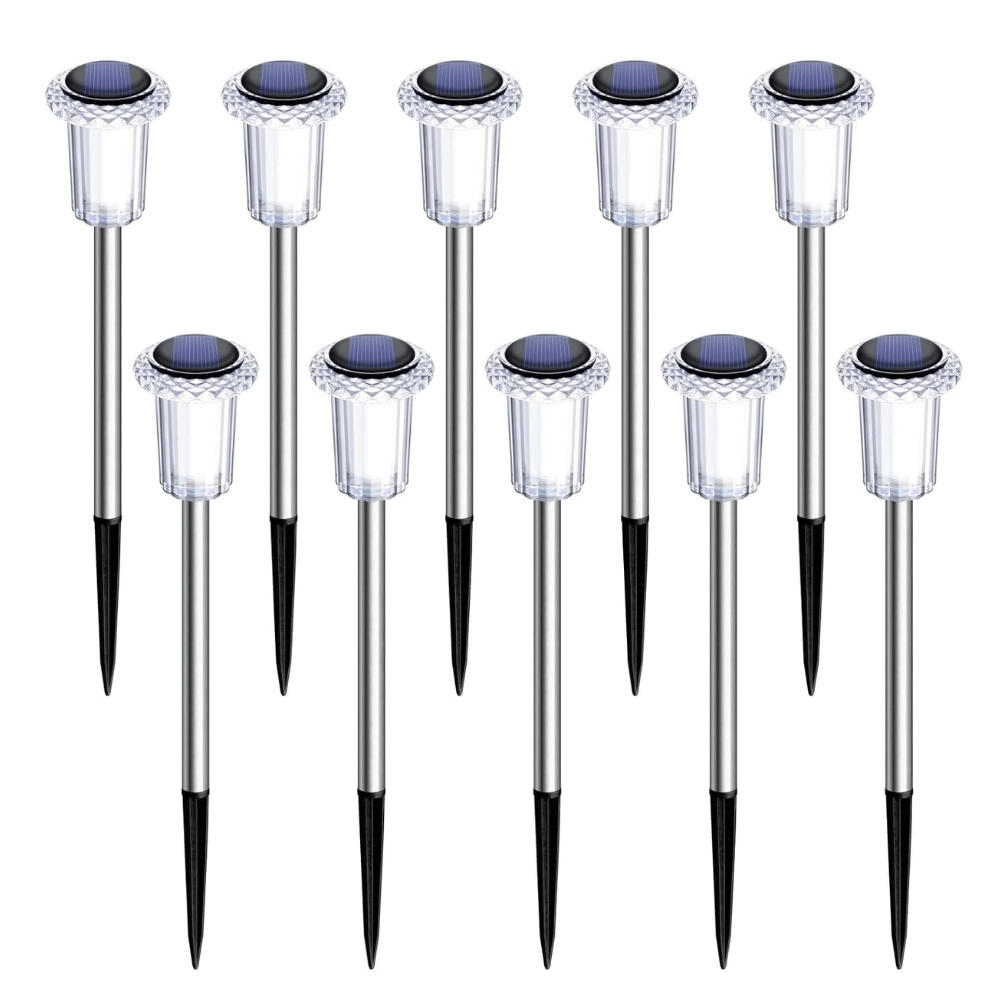
Quick answer: As a starting point, place solar path lights every 6 to 8 feet along one side of the walkway, give corners, steps, and the gate their own light, and only light both sides — staggered, not paired — on paths wider than about 4 feet. At that spacing a 10-pack runs roughly 54 to 72 feet in a single line.
Nobody regrets buying path lights; people regret where they put them. Too close together and the yard looks like an airstrip, too far apart and the path disappears between pools of light. This guide gives you a layout you can mark out with a tape measure in ten minutes — spacing, sides, and the spots that earn a light before anywhere else.
Light decisions, not distance
The purpose of a path light isn't to flood the route — it's to tell feet where to go. So before counting stakes, walk the path at dusk and note where you actually make decisions: the start of the path, every turn, any step or grade change, the gate latch, the door. Those points get lights first. Whatever budget remains fills in the straights. A path with lit corners and dark middles works; the reverse doesn't.
Spacing: start at 6 to 8 feet
There's no building code for decorative path lighting, so treat spacing as a style choice with a sensible default. Six to eight feet between stakes is the range most landscapers start from, and it behaves like this:
- 4–6 ft apart: a bright, defined ribbon of light — good for busy front walks and where guests arrive at night.
- 6–8 ft apart: the balanced default — continuous guidance without glare.
- 8–10 ft apart: subtle marker lighting — enough to trace the route through a garden you know by heart.
Decorative stakes like our 10-pack throw a patterned ring of light around each stake rather than a floodlit stripe, so if you're torn between two spacings, the tighter one keeps the rings reading as a connected line.
One side or both?
Paths under roughly 4 feet wide rarely need more than one lit side — both sides at that width feels crowded and doubles the cost for little gain. On wider walks and driveway edges, light both sides but stagger the stakes in a zigzag instead of placing them in facing pairs. Staggered light overlaps in the middle of the path, looks intentional, and avoids the runway effect that paired lights create.
The math for a 10-pack
Our Pack of 10 Solar Pathway Lights ($19.99–$29.99 by color, 13 inches tall, rated IP65 with a listed 10–12 hour runtime) is the anchor product here, so here's what ten stakes cover as a starting point:
| Path length | At ~6 ft spacing | At ~8 ft spacing | Packs (one side) |
|---|---|---|---|
| 15 ft | 3 lights | 2–3 lights | 1 (with spares) |
| 30 ft | 6 lights | 4–5 lights | 1 |
| 50 ft | 9–10 lights | 7 lights | 1 |
| 80 ft | 14–15 lights | 11 lights | 2 |
Counts assume a straight single-side run (length divided by spacing, plus one to close the line); curves and extra decision points add a stake or two. Leftover lights never go to waste — flowerbed corners and the mailbox are the classic homes for spares.
Small placement details that matter
- Set stakes a few inches back from the path edge so string trimmers and mower wheels miss them.
- Check the sun budget before finalizing spots. The 10-pack lists 6–8 hours of direct sun for its full 10–12 hour runtime; a stake under a dense tree will charge less and quit earlier. Shift shaded positions a foot or two into the light where you can.
- Keep the line consistent. Uneven distances read as accidental. Cut a spacer stick to your chosen gap and use it for every stake.
- Push stakes into moistened soil, not dry hard ground, to avoid bending them.
Steps, decks, and other places stakes can't go
Ground stakes end where wood begins. For stair treads, deck perimeters, and railings, the right tool is a surface-mounted unit like our Outdoor Solar Deck Lights — semi-flush ABS fixtures, rated IP65 in the listing, with a warm white glow, sold in 16 and 20 light-source options at $39.99 and $48.99. Mixing the two is normal: stakes along the soil, surface mounts on the structure, and the path reads as one continuous route. For a whole-yard plan beyond the path, see our zone-by-zone lighting guide.
Frequently asked questions
How far apart should solar pathway lights be?
A common starting point is 6 to 8 feet between lights. Go tighter (4 to 6 feet) for a brighter, defined edge, or wider (8 to 10 feet) for subtle guidance. There is no single correct number - it depends on the light output and the look you want.
Should I light both sides of a path?
For paths under about 4 feet wide, one side is usually enough. On wider paths and driveways, light both sides in a staggered zigzag rather than facing pairs, which can look like a runway.
How many lights do I need for a 30-foot walkway?
At 6-foot spacing, about six lights on one side; at 8-foot spacing, four or five. A 10-pack covers either plan and leaves spares for a corner or the gate.
What if part of the path is shaded?
Solar stakes need direct sun. The 10-pack we stock lists 6-8 hours of daylight charging for its rated 10-12 hour runtime, so shaded stakes will run shorter. Shift them just outside the shadow line where possible.
What should I use on steps and deck edges?
Stakes cannot go into wood. Use surface-mounted solar deck lights there - they sit semi-flush on the structure - and keep staked lights for soil and grass.
More from the Solar Wind LED Chime blog
- Pack of 10 Solar Pathway Lights — specs, runtime and setup
- Outdoor lighting by zone — porch, path, fence and garden
- Solar garden fountain guide — setup, placement and care
- Shop pathway & garden lights
Spacing figures are general guidance, not measurements from the manufacturer — adjust to your space and the effect you want. Prices and specifications are current as of publication and may change; see each product page for the latest details.