

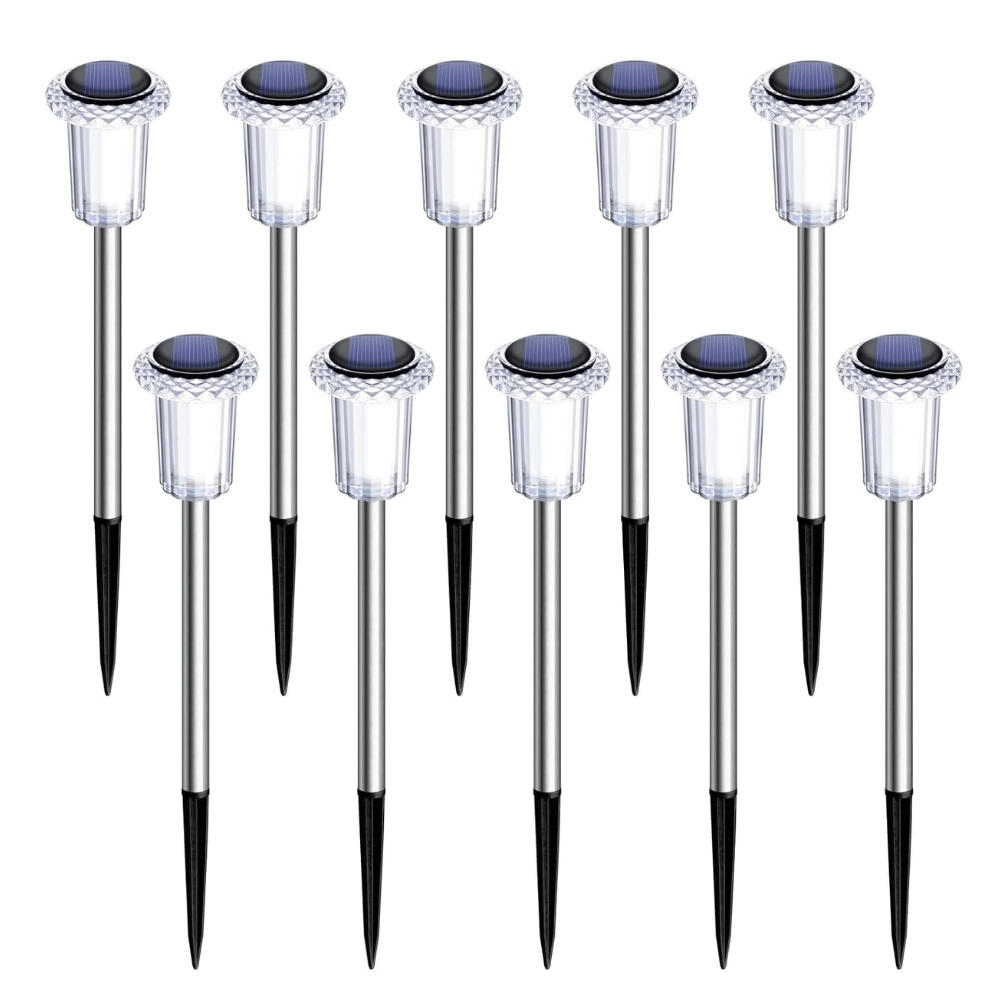
Quick answer: Every solar garden light is three parts in a housing: a photovoltaic panel that turns daylight into electricity, a small rechargeable battery that stores it, and a sensor that switches the LED on at dusk. Runtime depends on how much the panel banked that day — our pathway lights list 10–12 hours of glow after 6–8 hours of direct sun.
Solar lights feel like magic when they work and like junk when they don't — and the difference is almost never the light itself, but whether its three components got what they needed. Understanding those parts takes five minutes and upgrades your placement decisions, your expectations, and your ability to diagnose the classic "it worked great in July, why is it dim in November?" mystery.
Part one: the panel
The panel on top is a photovoltaic cell — sunlight in, current out. Output scales with light intensity, hence every listing saying some version of "place in direct sunlight." Our 10-pack pathway lights use polycrystalline panels; their listing is specific: 6–8 hours of direct sun for a full charge. The panel is also the part you can maintain — dust, pollen, or snow cuts charging, hence "wipe the panel" in nearly every care note we carry.
Part two: the battery
Daylight and lighting demand are twelve hours out of phase, so every solar light carries a rechargeable battery as the middleman. Size varies by job: pathway lights run a small AAA-size 1.2V 250mAh Ni-CD cell (a fresh one every 12–18 months, per the listing), the $9.99 motion puck uses a built-in lithium cell, and the 3-head security light steps up to 2,000mAh for its 210 LEDs. Age shows here first: panels last years, but cells fade, so a dimming light usually needs a battery, not a bin.
Part three: the sensor
The automatic on-at-dusk behavior comes from a photoresistor watching ambient light: dark triggers the LED on, dawn flips it off and charging resumes. That's the "dusk-to-dawn" feature — and why a light under a bright streetlamp can act confused, a scenario the motion puck's listing warns about directly. Motion-sensing models add a passive infrared sensor that watches for moving heat within a listed range (about 10 ft/120° on the puck, up to 26 ft on the 3-head), triggering full brightness on demand instead of burning charge all night.
What listed runtimes actually mean
Runtime figures describe the full-charge case. Our products' listings, side by side:
| Product | Listed runtime / behavior |
|---|---|
| Solar color-changing chime | 8–12 hours on a full charge |
| Pathway lights (10-pack) | 10–12 hours after 6–8 hours of direct sun |
| Post cap lights (Dual Mode) | Steady through dusk and early evening, then gradual dimming as charge depletes |
| Motion puck / 3-head | On at night, off at sunrise; motion modes stretch the stored charge |
Notice the pattern: a range or a description, never a single number, because the input varies daily. A gray day banks a smaller charge — a shorter evening, or a dimmer one. The Dual Mode post cap listing describes it plainly: output holds steady early, then eases down as power runs out. That behavior after cloudy weather is normal, not a fault.
Placement: paying the panel first
Every placement decision is a charging decision. The rules that follow:
- Chase direct sun, not brightness. A spot that looks bright to the eye can be all shade; track where sun actually falls for 6+ hours.
- Mind seasonal shade. A tree bare in March is a solid canopy in July, and the sun sits lower in winter — a spring-perfect spot can fail by December.
- Keep panels clean and unobstructed — the pathway lights' care notes flag checking that panels stay clear in rain and snow.
- Keep night dark around the sensor. Nearby artificial light can delay or prevent switch-on.
Why this beats wired lighting for gardens
Each light is a sealed, self-sufficient unit: no trenching, no outlets, no electrician — adding a light to the far corner of a garden costs exactly the light. Every fixture is independent too: one shaded unit dims without affecting its neighbors. The trade-off is a daily energy budget, manageable once you place for the panel. For a store like ours, that's the premise: six of our eight best sellers run on nothing but daylight.
Frequently asked questions
Do solar lights charge on cloudy days?
Yes, but at a reduced rate - the panel produces less current in overcast light, so the battery banks a partial charge and the night's glow runs dimmer or shorter. A string of gray days compounds the effect.
Do solar lights need batteries replaced?
Eventually, on models with accessible cells. Our pathway lights use replaceable AAA-size rechargeables and the listing suggests a fresh set every 12-18 months. Fading runtime on an older light is usually the battery, not the panel.
Why does my solar light not turn on at night?
Check three things in order: the on/off switch (many ship switched off), the panel (shade or grime means no charge), and nearby light sources - a streetlamp or porch light can convince the dusk sensor it is still daytime.
Can I leave solar lights out in rain?
Outdoor-rated models, yes - our pathway and motion lights carry IP65-class sealed housings built for rain and snow. Check each product listing for its stated rating before leaving anything out year-round.
How long do solar lights take to charge?
Our pathway lights list 6-8 hours of direct sunlight for a full charge, which is typical of the category. Less sun still charges them - just proportionally less runtime that night.
More from the Solar Wind LED Chime blog
- Solar lights in winter and cloudy weather — honest expectations
- Solar post cap lights — the complete fence lighting guide
- Solar wind chimes — how they work and which style suits your space
- Shop the solar collection
Runtime, charge-time, and detection figures are the manufacturers' listed specs for each product, not independent lab results; real-world performance varies with placement, season, and battery age. Prices and specifications are current as of publication and may change.